
【Mexico】
Main production areas: Michoacán, Sinaloa, Los Cabos
Varieties: Haden, Kent, Honey Keitt

Gracias Mango is the finest mango, carefully selected with flavor as the highest priority, produced by Rainbow Fresh, a company specialized in mangoes.
Built upon rigorously selected production areas and varieties, every stage—from quality control to freshness preservation through air transportation—is carried out with meticulous craftsmanship and deep passion.
Strict standards are applied across all aspects, including variety, flavor, weight, transportation, and management, ensuring consistent excellence.
With low fiber and a smooth, silky texture, Gracias Mango offers a gentle aroma, refined sweetness, and well-balanced acidity.
The rich depth of flavor that unfolds in the mouth truly makes it an exceptional fruit.
The brand name “Gracias”, meaning “Thank you”, embodies our heartfelt gratitude toward everyone involved with this fruit—producers, distributors, and customers alike.
1. Variety
From mangoes around the world, we carefully select varieties based on flavor, aroma, low fiber content, and a clean, pleasant finish.
We focus primarily on the highly regarded Kent variety, known for its smooth mouthfeel and subtle aroma.
Its layered umami and deep, refined flavor are the defining characteristics of the mangoes we deliver.
2. Weight
Each mango meets a minimum standard of 350 g per fruit, ensuring both visual presence and generous flesh.
The core 4L size (approximately 500 g) represents the perfect balance of quality and taste, making it a preferred choice for gifts.
3. Flavor
Strict control of harvest timing is our highest priority.
At the production sites, mangoes are harvested only after carefully assessing ripeness to ensure peak flavor when enjoyed in Japan.
4. Transportation
All mangoes are imported exclusively by air.
By transporting them via the shortest possible routes from harvest to arrival at Narita Airport, we preserve the fruit’s natural aroma and freshness.
Upon arrival, each mango is promptly inspected, and only those in optimal condition are delivered to our customers.
5. Management
After arrival in Japan, every mango is individually inspected with great care.
Using our proprietary ripeness chart, we deliver mangoes at the precise ripeness requested by each customer.
Through continuous communication and feedback with production areas, we strive for ongoing improvement in quality.
① Haden
Main production areas: Mexico, Hawaii
Haden was the first mango variety to achieve commercial success in Florida and is considered the parent variety of many well-known cultivars, including Kent and Irwin.
It is characterized by a rich aroma and deep sweetness and is regarded as a classic example of the traditional apple mango.
② Kent
Parent varieties: Haden × Brooks
Main production areas: Mexico, Peru, Brazil
Kent mangoes are known for their low fiber content, smooth flesh, and mild, unobtrusive aroma.
Their refined and mellow sweetness makes them ideal even for those trying mangoes for the first time.
In Japan, Kent is a highly popular premium variety, often requested by name.
③ Irwin
Parent varieties: Haden × Lippens
Main production areas: Japan, Taiwan
Irwin is the most widely cultivated apple mango variety in Japan.
It is rich in juice, with a well-balanced sweetness and acidity, and features a beautiful red skin.
With its appealing aroma, vibrant color, and excellent flavor, it is considered one of Japan’s representative mango varieties.
④ Honey Keitt
Parent variety: Seedling of Haden
Main production area: Mexico
Due to its limited harvest period, Honey Keitt is often referred to as a “phantom mango.”
This late-season variety produces large fruits with thick flesh, where concentrated sweetness harmonizes with refreshing acidity.
⑤ Kensington Pride
Parent lineage: Seedling derived from mango seeds introduced from India and Southeast Asia
Main production area: Australia
Kensington Pride is the most iconic mango variety in Australia and is also affectionately known locally as the Bowen Mango.
The flesh is slightly fibrous yet juicy, featuring dominant sweetness and a distinctive tropical aroma.
⑥ R2E2
Parentage: Kensington Pride × natural cross-pollination
Main production area: Australia
The name “R2E2” comes from its original planting location in a test orchard (Row 2, Experiment 2), and it is often affectionately compared to the character R2-D2 from Star Wars.
The fruit tends to be large in size, with low fiber content and a gentle, well-balanced sweetness.

“Harvested at the perfect tree-ripened moment and delivered with freshness intact.”
Tree-ripened mangoes, fully matured on the tree, are harvested at the optimal timing and swiftly transported by air.
By delivering them to Japan without delay, their aroma, sweetness, and texture are preserved at their absolute peak.
The unique harmony of tree-ripened flavor and exceptional freshness, made possible only through air shipment, is the greatest appeal of this mango.

“Melt-in-the-mouth flesh, indulgent sweetness.”
Gracias Mango is a special mango among apple mangoes, composed only of carefully selected varieties chosen with uncompromising focus on texture and flavor, delivered seasonally in a relay-style program.
Its meltingly smooth flesh, rich sweetness that fills the palate, and abundant juiciness create a moment of pure indulgence with every bite.
Delicious on its own, the low-fiber, thick flesh also presents beautifully as cut fruit and is ideal for cakes, tarts, and other desserts—enhancing harmony, depth, and refinement in every creation.


Main production areas: Michoacán, Sinaloa, Los Cabos
Varieties: Haden, Kent, Honey Keitt

Main production areas: Piura, Tambogrande, Motupe, Casma
Variety: Kent

Main production areas: Curaçá, Juazeiro
Variety: Kent
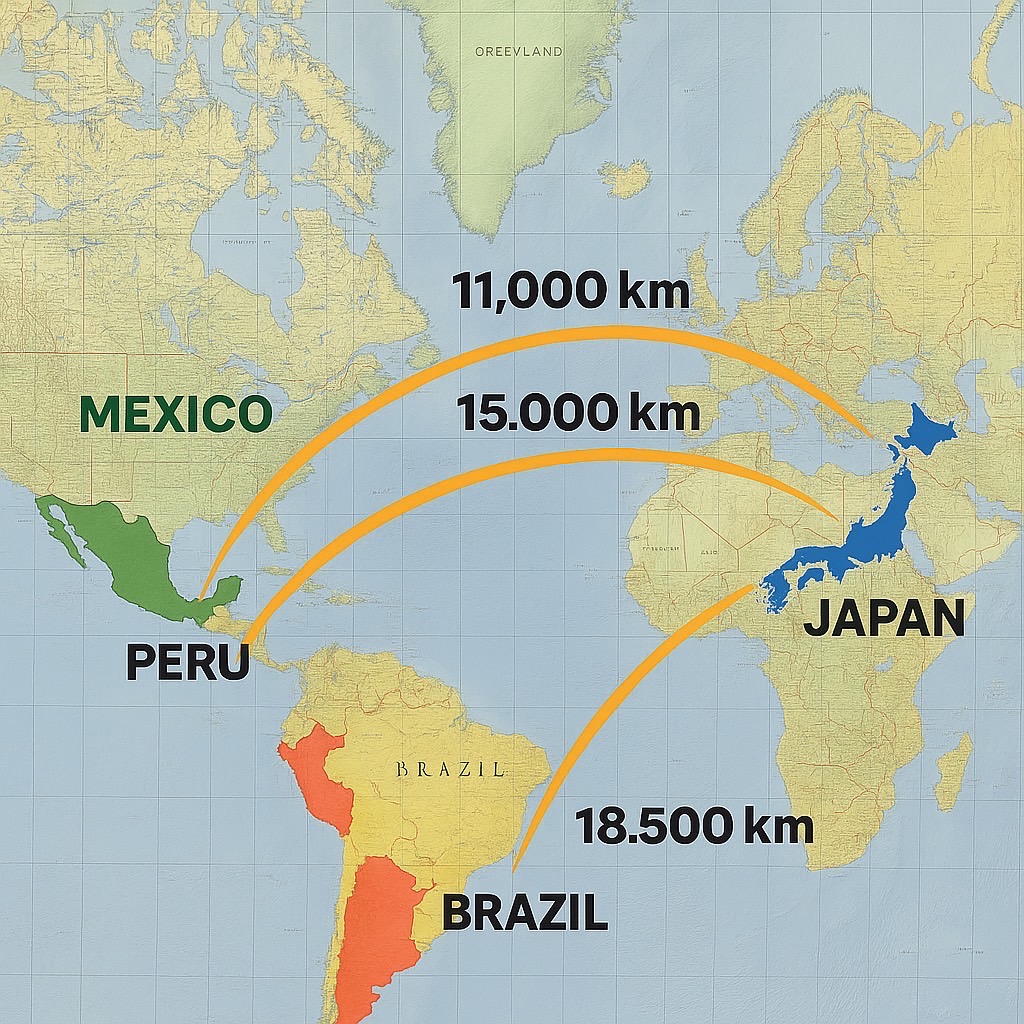
Gracias Mango is harvested fully tree-ripened in production areas in Mexico, Peru, and Brazil, then shipped directly to Japan by air while preserving freshness.
Thanks to air transportation, the mangoes arrive in Japan within just a few days after harvest, allowing us to deliver fruit that has fully matured on the tree in its absolute best condition.
Compared with conventional sea freight (approximately 25–50 days), there is an overwhelming difference in both transit time and freshness.
Unlike fruit harvested early to withstand long-distance shipping, Gracias Mango is allowed to mature properly at origin.
Working closely with local producers and export partners, we deliver truly delicious, fully ripened mangoes to be enjoyed in Japan at their seasonal peak.
Below is a comparison of transportation routes from each production area to Japan.
【Mexico】
■ Air Freight – Time & Distance
Mexico City (Mexico) → Narita International Airport (Japan)
Official airport name: Benito Juárez International Airport
IATA code: MEX
Distance: Approx. 11,000 km
Transit time: Approx. 14–15 hours by direct flight (operated by ANA)
• Continent: North America
• Latitude: North of the Equator → Northern Hemisphere
• Regional classification: Latin America (Central America / Latin America)
■ Sea Freight – Time & Distance
Mexico → Tokyo Port
Main ports: Manzanillo Port or Lázaro Cárdenas Port
Estimated transit time: Approx. 20–25 days
Typical route: Manzanillo → Yokohama or Tokyo
(direct service or via the U.S. West Coast)
【Peru】
■ Air Freight – Time & Distance
Lima (Peru) → Narita International Airport (Japan)
Official airport name: Jorge Chávez International Airport
IATA code: LIM
Distance: Approx. 15,000 km (varies depending on routing)
Transit time: No direct flights; approx. 22–28 hours including transfers
• Continent: South America
• Latitude: South of the Equator → Southern Hemisphere
• Regional classification: Latin America
■ Sea Freight – Time & Distance
Peru → Tokyo Port
Main port: Callao Port
Estimated transit time: Approx. 30–35 days
Typical route: Callao → Manzanillo (Panama) → Yokohama or Tokyo
(with transshipment)
【Brazil】
■ Air Freight – Time & Distance
São Paulo (Brazil) → Haneda Airport (Japan)
Official airport name: Guarulhos International Airport
IATA code: GRU
Distance: Approx. 18,500 km
Transit time: No direct flights; approx. 26–30 hours including transfers
Continent: South America
Latitude: Mainly Southern Hemisphere (some areas near the Equator)
Regional classification: Latin America
■ Sea Freight – Time & Distance
Brazil → Tokyo Port
Import track record: None to date
Main port: Santos Port
Estimated transit time: Approx. 40–50 days
Typical route: Santos → Singapore or Europe (via multiple transshipments) → Tokyo
【Reference】
Distance of Honshu, Japan
The straight-line distance from the northernmost to the southernmost point of Honshu, Japan’s main island, is approximately 1,300 km.
• Northern end: Ōma Cape, Aomori Prefecture
• Southern end: Around Shimonoseki City, Yamaguchi Prefecture
(also the westernmost point of Honshu)